
In accordance with SO #3423 - The Gulf of America and SO #3424 - Mount McKinley and Landmarks Honoring the Alaskan People, new USGS data releases specific to those named places will utilize the new name Gulf of America and the restored name Mount McKinley. Per USGS practice, historical data will retain the name of the geographic features as they were known at the time the data were originally released.
Data Release
Experimental Coral-growth and Physiological Data and Time-series Imagery for Porites astreoides in the Florida Keys, U.S.A.
By Ilsa B. Kuffner,1 Elizabeth A. Lenz,2 Lucy A. Bartlett,3 Anastasios Stathakopoulos,1 and Jennifer M. Morrison3
1U.S. Geological Survey, St. Petersburg Coastal and Marine Science Center, St. Petersburg, Florida, USA
2University of Hawaii, Hawai‘i Institute of Marine Biology, PO Box 1346, Kāne‘ohe, HI 96744, USA.
3Contracted to U.S. Geological Survey by Cherokee Nation Technologies, St. Petersburg Coastal and Marine Science Center, St. Petersburg, Florida, USA
Summary
The USGS Coral Reef Ecosystems Studies project provides science that helps resource managers tasked with the stewardship of coral reef resources. This data release contains data on coral-growth rates and time-series photographs taken of colonies of the mustard hill coral, Porites astreoides, grown at four sites on the Florida Keys reef tract from spring 2015 to spring 2017. The data will be used to inform resource managers on the spatial and temporal variability in heat stress and the response to it by P. astreoides along 350 km of the Florida reef tract. These data will be used to draw conclusions about the capacity of this species to persist in Florida and throughout the western Atlantic as ocean conditions continue to change. The datasets included here were interpreted in Lenz and others (2021).
Lenz, E.A., Bartlett, L.A., Stathakopoulos, A., and Kuffner, I.B., 2021, Physiological differences in bleaching response of the coral Porites astreoides along the Florida Keys reef tract during high-temperature stress: Frontiers in Marine Science, https://doi.org/10.3389/fmars.2021.615795.
Data
*Note: To view the tabulated portions of this dataset in tab-delimited format, arranged by column, please use the Excel spreadsheet included in the download file.
| File Name and Description | Metadata (XML format) | Metadata (text format) | Download File |
|---|---|---|---|
| Pastreoides_growth_FL_USA.zip Data describing the growth and condition of the coral Porites astreoides from 2015 to 2017 at four offshore coral reefs in the Florida Keys during four time-intervals (.csv, .xlsx) |
Pastreoides_growth_FL_USA.xml | Pastreoides_growth_FL_USA.txt | Pastreoides_growth_FL_USA.zip (41 KB) |
| Pastreoides_end_measurements_FL_USA.zip Data describing the physiological condition of Porites astreoides corals at the end of the experiment in 2017 grown at four offshore coral reefs in the Florida Keys (.csv, .xlsx) |
Same as above | Same as above | Pastreoides_end_measurements_FL_USA.zip (31 KB) |
| FL_Pastreoides_photo_record.zip Photographic time-series images of coral condition during the growth experiment (.jpg) |
Same as above | Same as above | FL_Pastreoides_photo_record.zip (188.6 MB) |
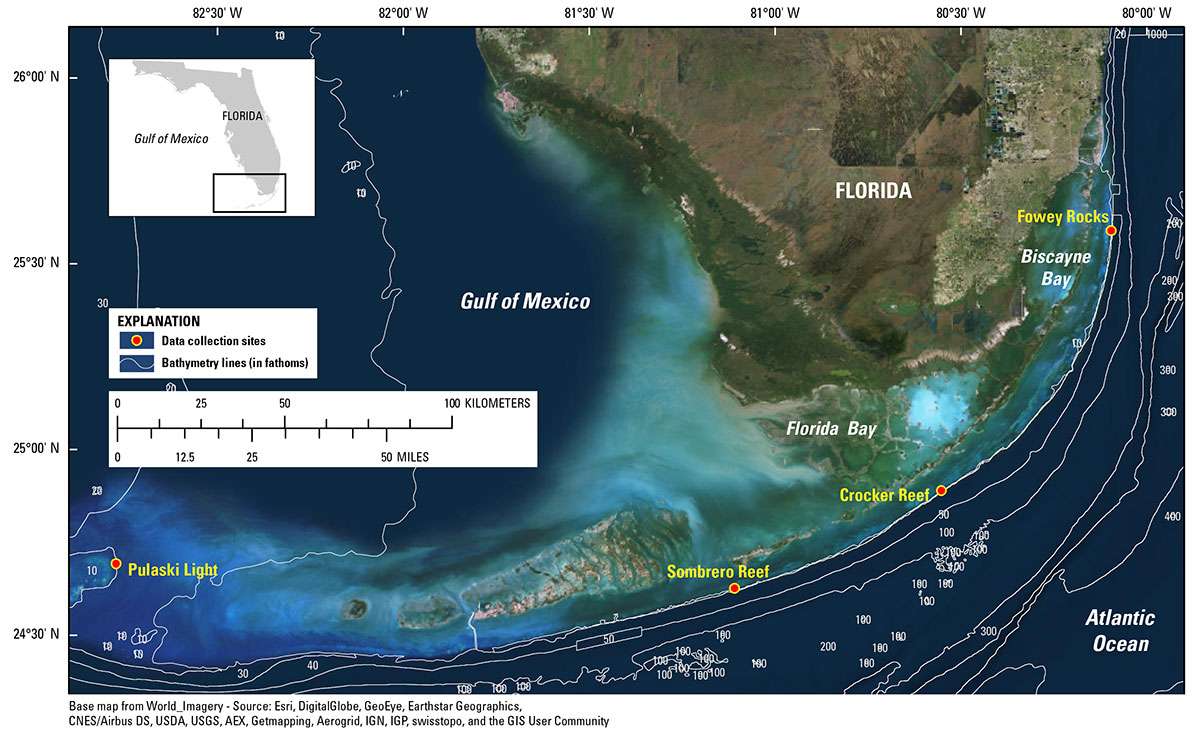
Figure 1. Location map showing sites (red circles) where datasets included in this data release were collected. Sites are Pulaski Shoal Light (24.69355°N 82.77280°W), Sombrero Reef (24.62687°N 81.10893°W), Crocker Reef (24.90908°N 80.52665°W), and Fowey Rocks (25.59047°N 80.09560°W).
Suggested Citation
Kuffner, I.B., Lenz, E.A., Bartlett, L.A., Stathakopoulos, A., and, Morrison, J.M., 2021, Experimental coral-growth and physiological data and time-series imagery data for Porites astreoides in the Florida Keys, U.S.A.: U.S. Geological Survey data release, https://doi.org/10.5066/P955KBD3.